

The Claude Sonnet 4.6 was launched on February 17, 2026, and represents a significant improvement over Sonnet 4.5. The model is one of the best models for the price you are paying. Its coding performance is comparable to the Opus 4.5, which is great since we are getting the same coding capabilities at a lower cost.
Coding
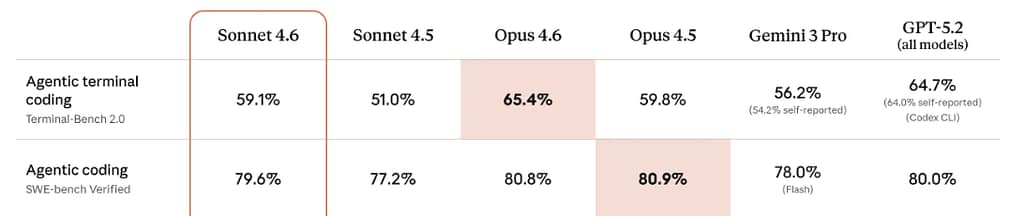
We have been testing the model on Cline, Antigravity, and GitHub Copilot Chat, and the model has been good for coding tests and thinking tasks. We have been using Claude Sonnet 4.6 on the Claude website, and the performance has been better than Sonnet 4.5 since it has a longer 1M context window and it can hold much more project data than the previous models. In the SWE Bench, it scores almost 80%; and in Terminal Bench 2.0, it scores 59.1%, which are good scores.
We had tried the model on .NET projects and Kotlin projects, and its performance was excellent, and since the model was for free usage on the client, we used it for long projects, and its performance on the projects was excellent, and it handled long context very well, and in many tests, its performance was better than Gemini 3 Pro with fewer bugs and errors, and when we gave it a task for finding issues and fixing them, it was pretty quick too, taking less time, and when we gave it a task of creating an SVG too, its performance was excellent.
Improvements
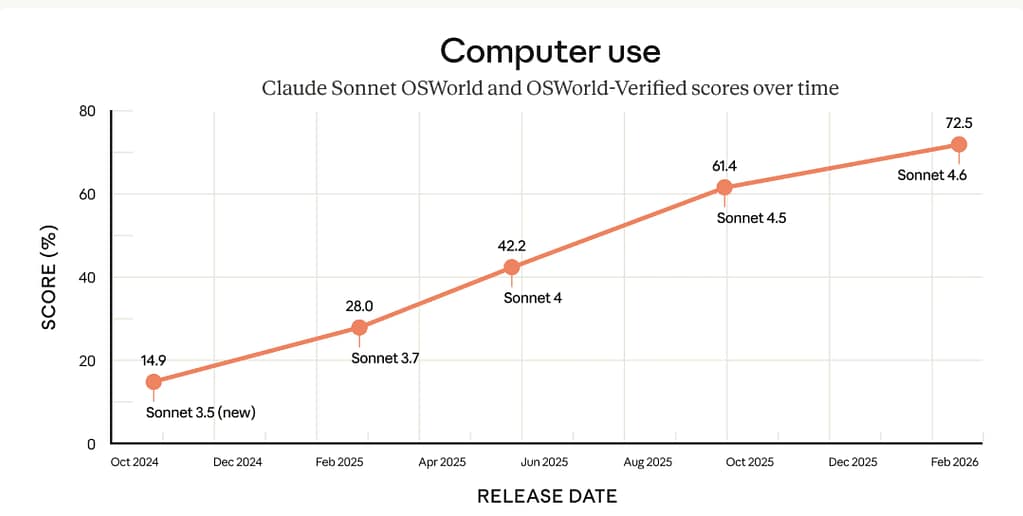
The Sonnet 4.6 was excellent in agentic computer use, scoring 72.5%, which is just a small bit slower than the Opus 4.6, and this performance is near the human-level capability in tasks like navigating a complex spreadsheet and filling a multi-step web form, and the model is still lagging behind the most skilled humans at using computers. But the rate of progress has been pretty excellent. For the office tasks based on the GDP value, AA elo is the highest ranker on its benchmark, which is an excellent result for the model.

Certainly there have been improvements made on how the model reacts to the user, and it’s better than the GPT 5.2 in the reasoning tasks too, which is an excellent performance. In the visual reasoning, the performance has been better than the Sonnet 4.5 and in some tasks even outpacing the 4.5 and 4.6 without tools, and it scores 75.6 with tools, which is an excellent score, and in ARC AGI 2, it scored 2x or higher than the 4.5 model. On the finance agent 1.1, it’s the highest scorer again, and in the agentic search too, it brings nice improvements vs. the prior generation, and in humanity’s last exam, it brings a nice uplift.
Availability, Pricing
Sonnet 4.6 is available on Google’s Antigravity, GitHub Copilot, Cline CLI, Claude Code, and the Claude website. It maintains the same price as the Sonnet 4.5 for the API, which is excellent since we are getting better reasoning and better coding for the same price. Additionally, the rate limits on the free tier have been increased. While Sonnet 4.5 allowed for only 3-4 prompts and then it would become rate-limited, Sonnet 4.6 now permits more than 10 prompts, which is a significant improvement.
Security
The Sonnet 4.6 has been improved in security this time, and with the tests done by Claude, it’s as safe or safer than other recent Claude models, and computer use poses risks like prompt injection attacks, where malicious actors can attempt to hijack the model by hiding instructions, and the safety evaluation done by Claude concludes that the Sonnet 4.6 is a major improvement compared to its predecessor, the Sonnet 4.5, and performs similarly to their flagship Opus 4.6.
Speed
In my testing, while yes, it takes a similar amount as the 4.5, it provides cleaner and better codes; the longer context area would allow the user to use the 1M context window without compacting the context, etc., so the user can do more tasks before the model forgets the context, which is a plus point in this generation.
We hope that you have enjoyed this article. For more information on electric vehicles, artificial intelligence, innovation, and the technology that will shape the future, continue to browse TechOrbis. At TechOrbis, our aim is to provide insightful analysis, honest views, and meaningful perspectives that extend beyond the news.
Follow TechOrbis on X (formerly Twitter), Instagram, LinkedIn, and Telegram to keep up with the latest news, trends, and tech talk. As a growing and independent source of news, every view, share, and mention helps us reach more people and continue to provide meaningful tech journalism.


